Why can’t I just get on with my life? Why can’t I just get on with life since I lost my job, my relative, my relationship broke up, I had surgery,got ill, burnt out. Why is grief so difficult when it happens to all of us at some point?
Bereavement can be tough even when you see it coming as a person is ill or they are frail. I was very fond of my aunt. She was 95 and in a care home, one day she was in the home and I’d dropped some more clothes off, that same evening she was in hospital and they said they’d make her comfortable overnight. But she died in the night. Gone. I had always known when I experienced a significant bereavement that it would be tough as I had never really got close to many people as a child, and my family buried grief, and so I had not experienced the pain of loss. I also did not know what to expect. Walking back into my aunt's room to collect her things soon after she died was really hard. In an instant I decided to take everything I wanted from her room so I did not need to go back. The loss hit me physically as I walked into her room and she was not there.
I knew grief was an emotional journey of loss, but it did take me by surprise how physically exhausting it was, and how stuck emotions could get inside me, even though I was quite emotionally aware. But no amount of going to funerals or watching people grieve from the outside prepared me for what was coming. Planning a funeral, dealing with paperwork and clearing a house of 50 years of accumulated family stuff and letting go of my dear aunt.
Grief is a natural reaction to a major loss that can be identified. Your loss may be the death of a person or it may be less visible or tangible; the loss of a job, a relationship, relocating, divorce or health issues that reconfigure your life and your expectations. It may be expected, or it may be unexpected. Unexpected loss is generally tougher to deal with but still it needs processing and often we have no grid for it. They teach us to count and read at school and to pass exams but unless you have been fortunate to grow up in a family with a great openness and vulnerability about emotions you are unlikely to have been taught grief 101 how to cope. You are more likely to have been taught consciously or otherwise to stuff the emotions down and ignore them, and try and just keep going. This normally requires working hard and being very busy to keep the lid on the sea of emotions you are denying. I did that when my mother in law died and did not even realise I had not given myself permission to grieve, until I had a peer supervision session at work followed by a 1:1.I activated some bereavement listening support as I realised I needed to address the way I was feeling.
So how did I process the loss of my aunt? The first few weeks I was numb and did the necessary legal things. But gradually over time the numbness wore off. Sometimes I would feel a heaviness sit inside me, sometimes I would wake in the night and just could not get back to sleep as I usually did. My band width for life was low, I had little capacity for change or new things and sometimes normal life just felt like very hard work. Grief is physically and emotionally tiring as the brain tries to put together a new reality without what you have lost.
So how did I cope? What did I do? I needed to acknowledge the loss. There may be several layers to your loss; for me I had lost my aunt but it went deeper than that I had lost a significant kind and early presence from my life.
I used some journal prompts to help me express what I was feeling, in the middle of the night if
needed when I couldn’t get back to sleep (which was unpredictable and irregular even after the first week or so). Writing for 20 minutes or so, writing what I felt, why I wanted her to come back, why it was hard knowing she wasn’t there for me to visit. I wrote until the words dried up and I felt a sense of peace and often then I could go back to sleep.
The Role of Journaling in Grief and Recovery | Psychology Today This article explains some of the science behind how journaling helps us.
I had learnt when my mother in law and my husband's aunt had died close together previously that I needed to be kind to myself.I needed to be aware of my emotional tank and capacity for each day. The tank did not have the capacity I was used to. So I needed to accommodate that, I needed to plan less things in my non-working time.I needed to make sure I did something I enjoyed every day, however little. A walk, a painting,some crafting, knitting, painting, take a breather. I also meditated on scripture about God's love and comfort in loss.
The biggest learning was that we all have a capacity and when grieving the process of grieving takes up more capacity than I expected. I knew that loss was something we all walk through and we need to adapt to it and process it and eventually joy and our capacity to live with joy in our life returns.
I wanted to remember my aunt, initially I wasn’t sure how I wanted to do that. Over time I remembered fondly two specific cardigans she had knitted. One for me as a child and one she had knitted for one of my children ( I still don’t know why I gave it to someone else) however when we cleared her bungalow I found the knitting patterns for them. I decided with the help of a friend to knit two cushions. Each with the pattern from the cardigan she knitted. One had rabbits running around the bottom, the other had little ladies around the bottom edge, complete with plaits. These cushions would remind me of the love and kindness she showed by knitting for me and my children for as long as I can remember; until she stopped knitting. I also had a some of her jewellery
made into a necklace, the small stones creating a picture that symbolised her to me.
As with all traumatic events when we process it we eventually come out the other side richer and deeper and different to who we were before. Sometimes though it takes courage to face the difficult emotions but I can testify that it is worthwhile, as joy does eventually return and with it often compassion for people going through similar situations. For me attending a The Bereavement Journey course was a really helpful part of my journey.
Kintsugi pottery illustrates this concept. Kintsugi is the general concept of highlighting or emphasizing imperfections, visualizing mends and seams as an additive rather than absence or missing pieces. It is a process of improvement through destruction and repair.
How to process loss:
Step1: Acknowledge what you have lost, a job, a relationship, your health whatever it is. Then it is important to recognise that whether the loss is visible ( as in a death or losing a job) or not
( internal change of health or status)
Step 2: Accept that there are emotions that you will feel that you need to acknowledge and process, on your own, in a group setting or with professional help, a coach or counsellor.
Step 3. You may find it really helpful to find a group or individual or is grieving and going on the same journey as you, I found it helped my understanding of the process of loss and it validated what I was feeling.
Step 4 Think about how you want to remember the person.They are no longer here but their memory can live on.
Stage 5 Think about what the next stage of life will look like; planning for positive changes and letting the door on the previous chapter close.
As humans we don’t tend to like uncertainty or unfamiliarity so change can be disorientating and unwelcome.. It can be hard to welcome the new chapter but we need courage to recognise that there will be a new chapter and we need to decide to embrace it. If we fail to embrace it and continue to look backwards we may well end up stuck living in a time warp unable to move on.
So whatever you have lost are you prepared to name it for what it is and go on the journey of processing the associated emotions so that you may enter a new chapter of life?
Sign up to my blog to receive future episodes. What new treasures may you find by embracing the journey of loss?
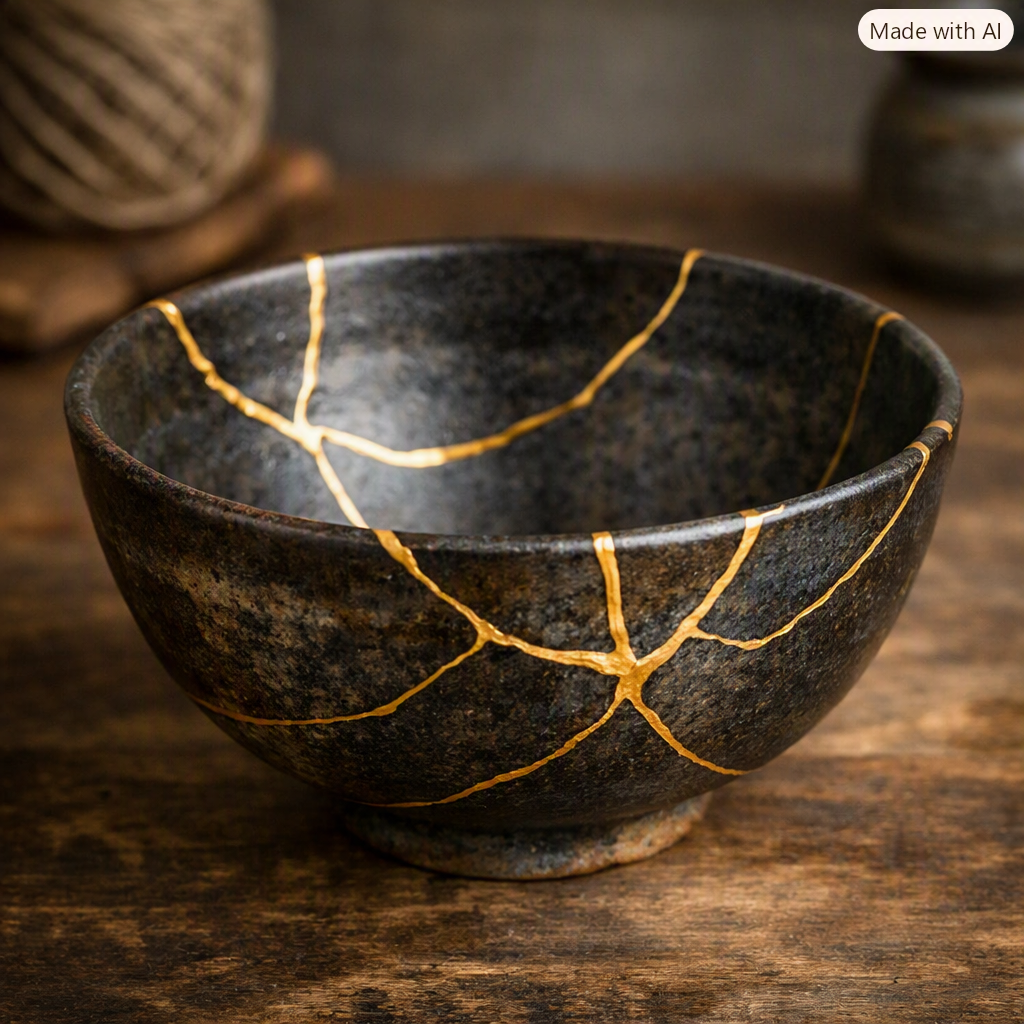
Kintsugi pottery
